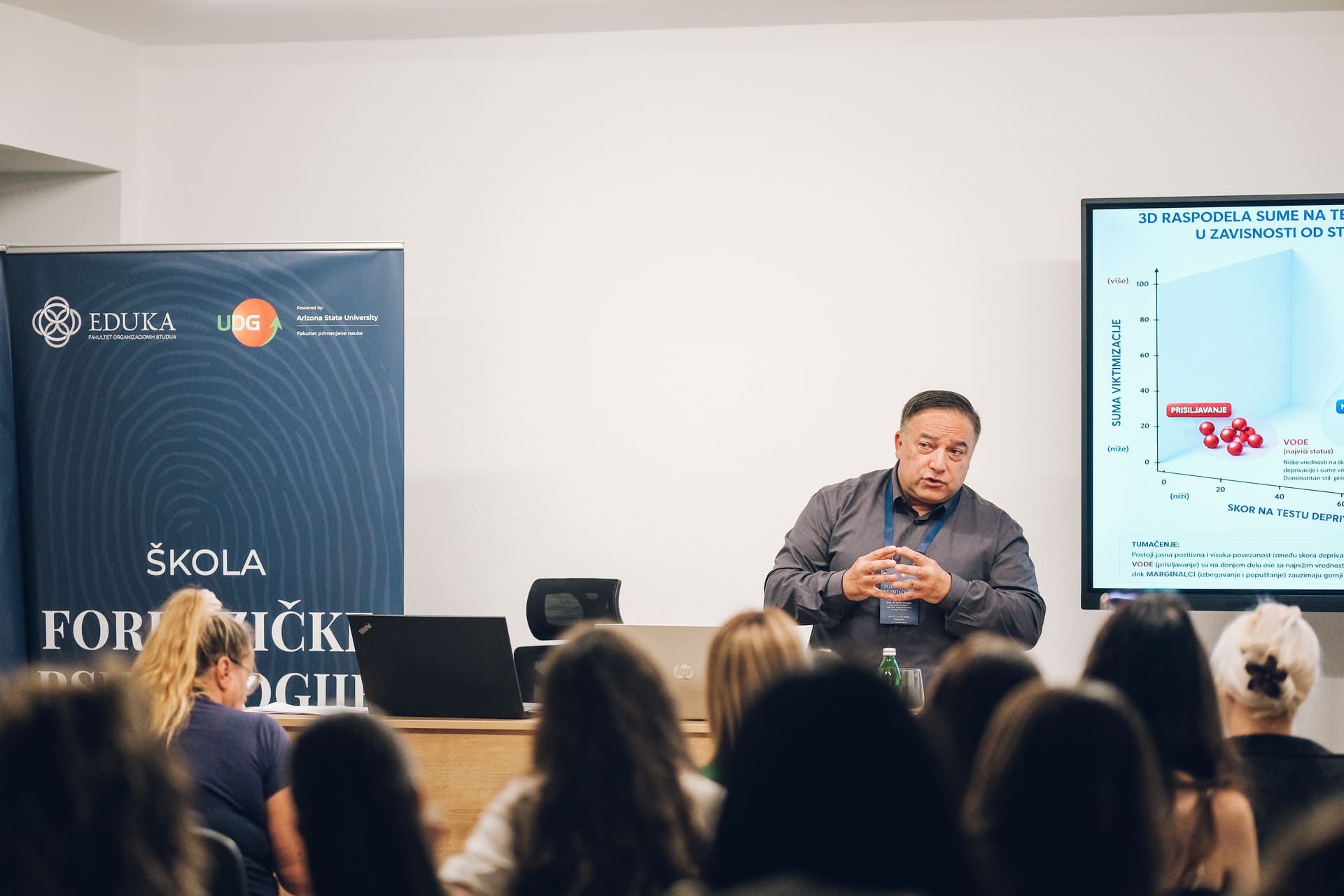


As part of the Summer School of Forensic Psychology program at the Faculty of Organizational Studies “Eduka,” a highly professional and content-rich lecture was delivered, introducing participants to one of the most sensitive topics in contemporary criminology, penology, and forensic psychology — the behavior of juvenile offenders in a prison environment.
The lecture was delivered by Associate Professor Dr. Goran Krstajić, a Doctor of Legal Sciences in the field of criminology and penology, with extensive professional experience as an inspector of the Ministry of the Interior at the only correctional facility for juveniles in Valjevo. Thanks to a unique combination of scientific work, empirical research, and direct experience within a closed-type institution, Prof. Krstajić provided participants with valuable insight into the psychological, social, and security structure of life among juvenile offenders.
The central topic of the lecture was the informal inmate structure that develops within a juvenile correctional facility. Prof. Krstajić explained how, alongside the official institutional rules, a parallel system of relationships, norms, status, and power is formed among inmates. This informal system often has its own hierarchy and rules of conduct, which can significantly affect the daily lives of juveniles, their interpersonal relationships, sense of security, and the possibilities for successful treatment.
Special attention was given to the issue of victimization within the institution. Through the presentation of empirical findings, Prof. Krstajić pointed out that the position of juveniles within the informal group structure directly influences their level of exposure to violence, pressure, and social marginalization. Participants had the opportunity to understand the differences between inmate subgroups, such as leaders, collectivists, and marginalized individuals, as well as the consequences that belonging to a particular group may have on psychological functioning, adaptation, and the safety of juvenile offenders.
The third important segment of the lecture addressed the challenges of resocialization under conditions of institutional deprivation. Prof. Krstajić explained how the opposition between the formal system of treatment and the hidden informal life of inmates can present a serious obstacle to the rehabilitation process. It was particularly emphasized that successful penological treatment cannot rely solely on formal rules and procedures, but requires a deep understanding of group dynamics, conflicts, status relations, and psychological mechanisms of adaptation to the prison environment.
The lecture had strong practical value, as it enabled students to connect theoretical knowledge from forensic psychology, criminology, and penology with real-world challenges of working in closed-type institutions. Through an interactive discussion on behavioral styles in conflict situations, participants gained clearer insight into the importance of recognizing hidden behavioral patterns, informal authorities, and risks of violence among juveniles.
The lecture by Prof. Dr. Goran Krstajić represented a highly significant contribution to the Summer School of Forensic Psychology, as it opened space for understanding the complex relationship between juvenile delinquency, prison subculture, victimization, and the process of resocialization. Through the integration of a scientific approach, empirical findings, and direct practical experience, participants gained valuable knowledge on how safer, more humane, and more effective models of working with juvenile offenders can be developed.