
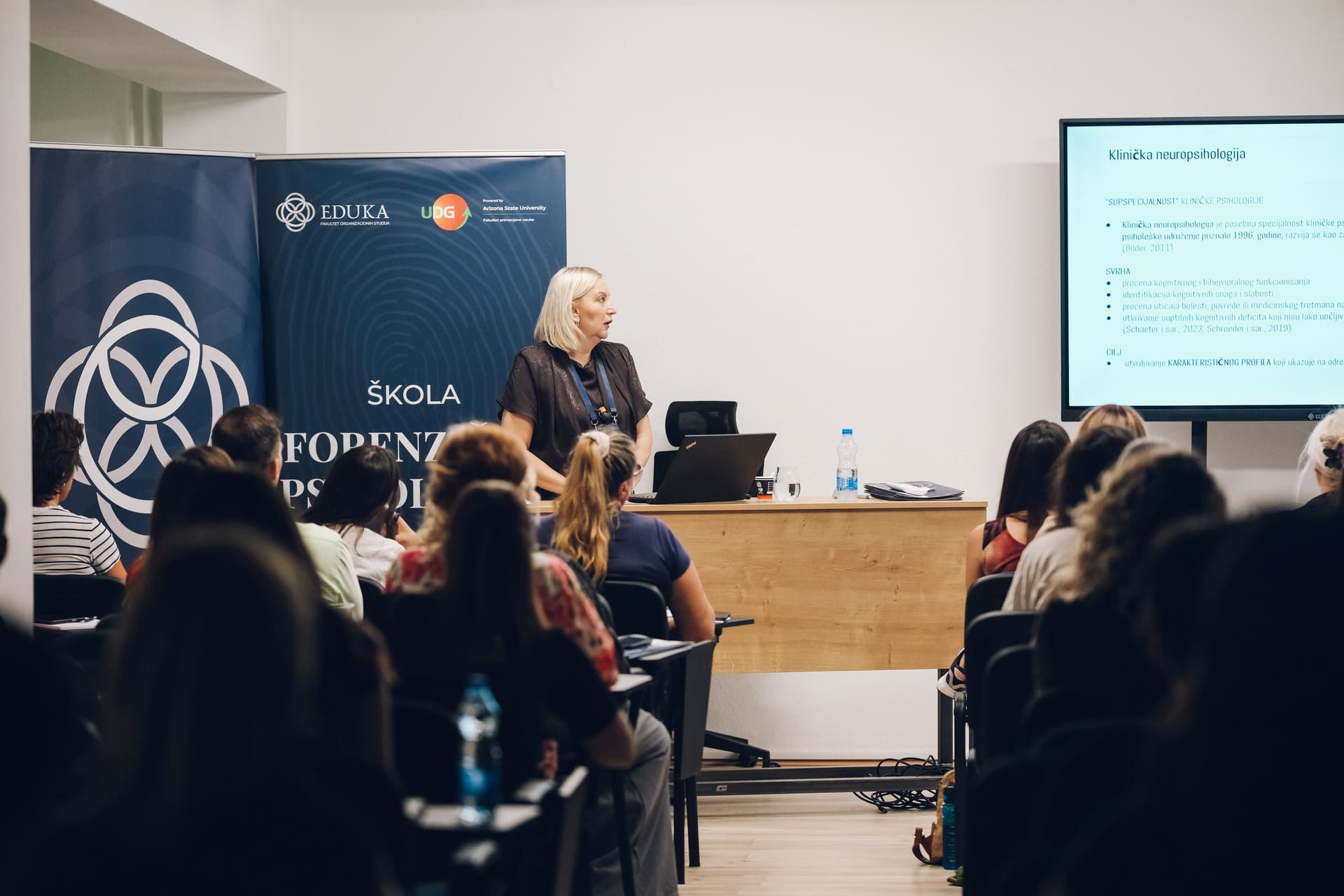
As part of the Summer School of Forensic Psychology at the Faculty of Organizational Studies “Eduka”, another highly significant professional lecture was held, this time dedicated to the topic of “Neuropsychology and Neuropsychological Expert Assessments”.
The lecture was delivered by Aleksandra Parojčić from the Institute of Mental Health, who introduced participants to an important and increasingly relevant field involving the application of neuropsychological knowledge in forensic and judicial contexts. Through a professional and clearly structured presentation, participants had the opportunity to understand how neuropsychological assessment can contribute to clarifying issues related to cognitive functioning, the ability to understand legal proceedings, decision-making, and the assessment of responsibility in judicial processes.
Special emphasis was placed on the role of the neuropsychological expert and the importance of professional assessments in situations where it is necessary to evaluate attention, memory, executive functions, verbal abilities, and other cognitive capacities of an individual. Aleksandra Parojčić explained how neuropsychological findings serve as an important support to the court in understanding the consequences of brain injuries, trauma, neurological conditions, or other changes that may affect behavior and reasoning abilities.
One of the particularly important segments of the lecture focused on the detection of malingering, that is, the identification of cases in which an individual intentionally fabricates, exaggerates, or inadequately presents cognitive difficulties. Participants were introduced to methods used for assessing the validity of statements and test results, as well as the importance of careful interpretation of data in a forensic context.
The lecture gained significant practical value through the presentation of testing materials and psychometric instruments used in neuropsychological assessment. Participants had the opportunity to see the structure of specific tests, learn how different cognitive functions are measured, and understand how test results are translated into professionally grounded findings relevant to the medical and judicial systems.
The lecture by Aleksandra Parojčić provided participants with valuable insight into how theoretical knowledge from neuropsychology is applied in real judicial practice. By connecting clinical assessment, psychometric testing, and forensic expert evaluation, participants of the Summer School gained a clearer understanding of one of the most responsible fields of contemporary applied psychology.