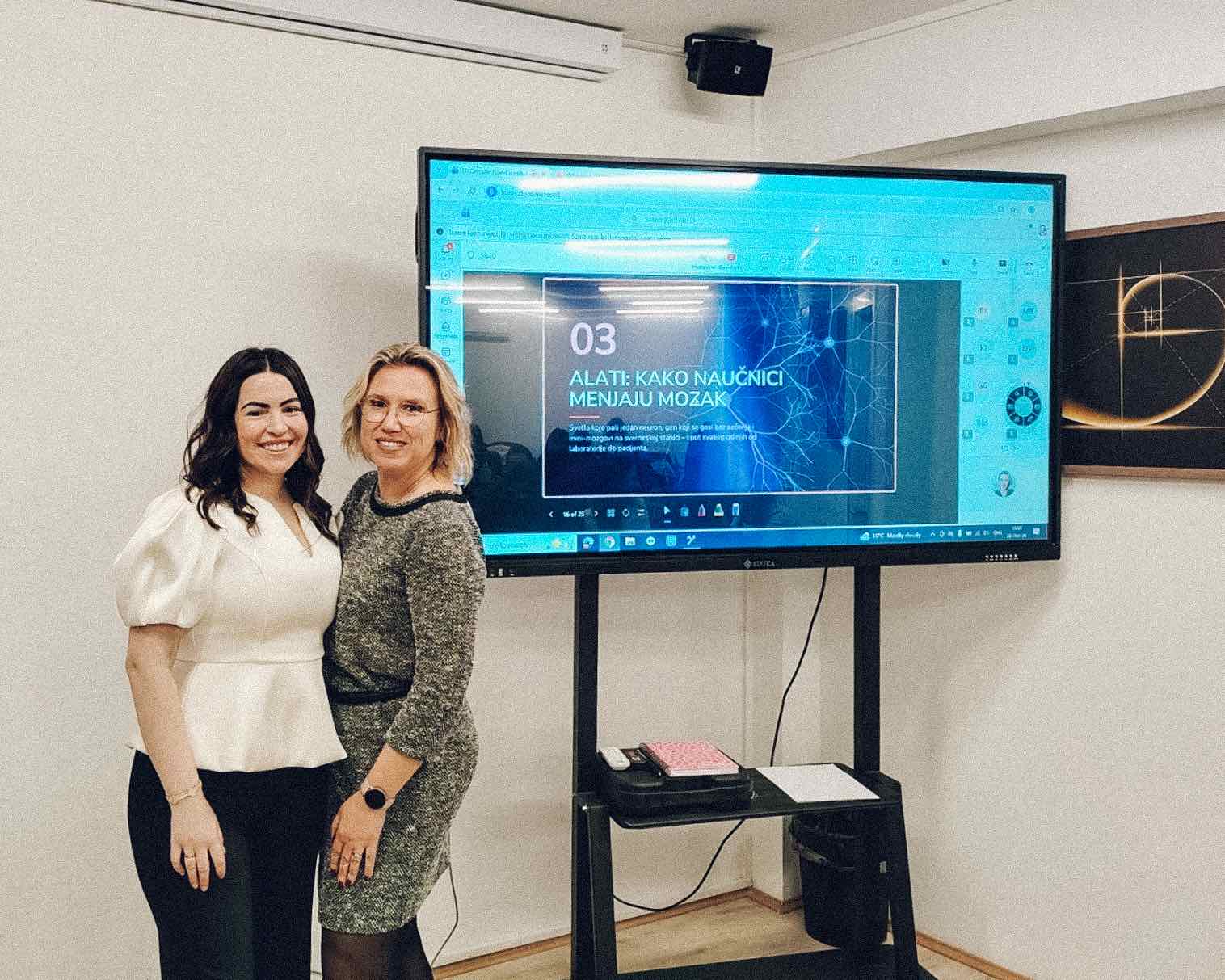


On 21 October 2026, the Faculty of Organizational Studies Eduka hosted a guest lecture entitled “Neuroscience: From the Fundamentals of Brain Function to the Latest Discoveries”, delivered to students by Željana Babić, a neuroscientist and the founder and CEO of Xenios.
The lecture was organized as part of the Introduction to Psychology course, taught by Prof. Ivana Jošanov-Vrgović, PhD. It provided students with an opportunity to expand their knowledge of psychology and explore contemporary approaches to studying the human brain and behavior.
Željana Babić, who studied psychology, neuroscience, and neurobiology at the University of California, San Diego (UC San Diego), introduced students to the fundamental principles of brain function, the mechanisms underlying emotions and memory, and modern technologies that enable new scientific insights into human behavior.
Special attention was given to optogenetics, an advanced research method that enables scientists to control the activity of specific nerve cells using light. This field is particularly relevant to our guest’s research. During a six-year research project, she used this technology to investigate how the brain draws on previous experiences when making new decisions.
Through examples from research practice, students had the opportunity to explore how theoretical knowledge in psychology connects with experimental research and technological innovation, as well as the importance of curiosity, critical thinking, and an interdisciplinary approach to scientific progress.
This was Željana Babić’s third guest lecture at our faculty, continuing a successful collaboration built on a shared interest in science, education, and passing on contemporary knowledge to new generations.
The Faculty of Organizational Studies Eduka thanks Željana Babić for her time, dedication, and willingness to share her extensive scientific and professional experience with our students.
Guest lectures of this kind are an important part of our educational approach, allowing students to complement their theoretical knowledge by meeting professionals who actively contribute to the advancement of science and modern technology.